Analysis of All-in-one LED Display Application Scenarios in the Chinese Market
The LED all-in-one video wall, a newly emerged category in the LED display industry, are currently being utilized in various scenarios such as conferences, education, exhibitions, and control rooms. According to the "Mainland China Small Pitch LED Market Analysis Report" released, in 2023, the shipment scale of the LED all-in-one machine market in mainland China will exceed 5,000 units.In terms of application fields, government and enterprise applications constitute the largest proportion, representing 64% of the total; business applications account for approximately 26%, primarily utilized in conferences, exhibitions, hotel banquets, and digital showcases; educational applications have reached a share of 7%; while medical training and remote terminal control comprise the remaining 3%.
The applications of government, enterprise, and business primarily focus on conferences and exhibitions, particularly in post-installation and mobile scenarios.
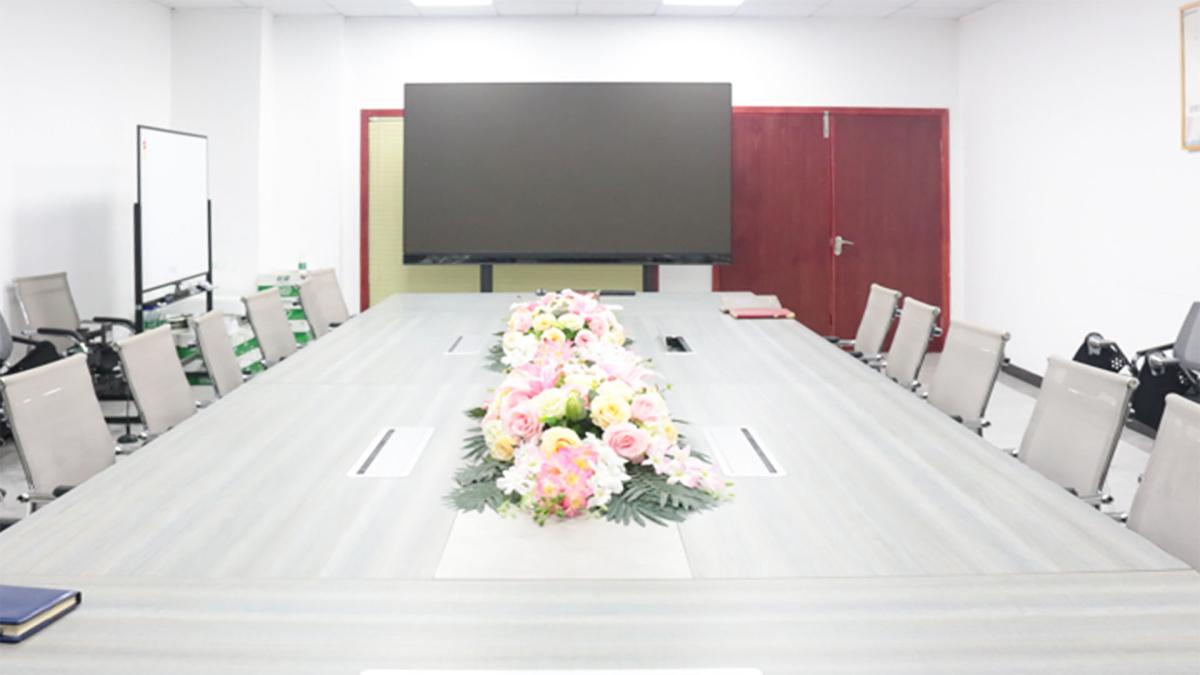
The applications of LED all-in-one machines in government, enterprise, and business sectors share similarities. They are primarily utilized in conference settings, including lecture halls, multi-function halls, hotel banquet halls, media studios, and other venues. Additionally, they serve display purposes for government affairs, corporate events, conferences, exhibitions etc. In fact, within the realms of government administration as well as enterprise and business industries exist numerous solutions for conferences and exhibitions such as LED all-in-one machines alongside LED splicing technology , LCD splicing systems , large LCD screens , projectors etc.
LED display products possess certain advantages over other display technologies. Firstly, the physical seams of LCD splicing screens are relatively large and can affect the overall appearance. This makes it less competitive in surveillance applications compared to LED displays. Secondly, oversized LCD displays have size limitations with a maximum size not exceeding 120 inches, while LED displays can be spliced according to required sizes. In conference scenarios, super-large and large conference rooms mainly use LED displays while small and medium-sized conference rooms use super-large LCD displays. Lastly, although projector equipment can be integrated and spliced according to needs, its lifespan is short compared to LED displays which can last up to 100,000 hours. Therefore, projectors compete more directly with LED displays in conference scenes.
When selecting product solutions, the government, enterprise, and business markets prioritize whether the product functions align with their specific requirements. The applications of LED all-in-one products are comparable to those of small-pitch LED splicing displays (fixed installation). Due to factors such as post-installation suitability, convenient mobility, and easy installation and maintenance, breakthroughs have been made in conference and exhibition scenarios within the government, enterprise, and business markets. An increasing number of users are opting for LED all-in-one products.
The current drawback of LED all-in-one machines lies in their pricing, as the cost of the P1.56 135-inch LED all-in-one product, although below 100,000 yuan, still exhibits a significant price differential compared to alternative technologies. Therefore, the key breakthrough for LED all-in-one machines is to attain an enhanced balance between "quality-price ratio.

The main areas of focus in education are teaching and reporting scenarios, which consequently give rise to the development of widescreen products.
The popularity of LED all-in-one machines in the education market is expanding, primarily utilized in teaching and reporting scenarios such as lecture halls, auditoriums, and training rooms within universities and training institutions. Enterprises are rushing to expand into the education field mainly due to two factors: first, policy guidance; second, seeking new incremental markets. At the policy level, there is a clear trend towards large-size display products in the education market. The "Interactive Electronic Whiteboard" standard issued by the Ministry of Education explicitly mandates that classrooms larger than 70 square meters (accommodating more than 50 people) must be equipped with a display size of at least 100 inches or larger. Secondly, within the education market, small-pitch LED displays and LED all-in-one machines possess consistent product characteristics while sharing similar distribution structures for spacing segments and procurement models akin to those used by governments and enterprises. Consequently, this has become one of the significant directions for enterprises to pursue new growth.
Judging from the distribution of LED companies in all-in-one machines, the size range spans from 108 to 220 inches. The largest share of shipments, reaching as high as 47%, is accounted for by sizes ranging from 131 to 140 inches. Sizes between 141 and 170 inches and between 100 and 130 inches account for approximately 28% and 20% respectively. Notably, sizes such as 108/110 inches,135/136/138 inches, and165 inches are the primary focus areas with significant advantages in the education market. Additionally, in order to cater to classroom teaching environments, companies have also introduced widescreen products with aspect ratios of both 32:9 and 21:9.
In general, the LED all-in-one products have been undergoing development in the market for a span of 5 years. KSSDISPLAY anticipates that by 2024, LED all-in-one machines will reach a new milestone in terms of technology advancement, cost optimization, brand diversification, market recognition, and overall influence. It is projected that within the next 3-5 years, the LED all-in-one machine market will expand into a multi-billion dollar industry.
Links: Conference All-in-one Display | Indoor LED Display | All-in-one Display Videos